
Season 17
1968-1969
Roster
Seniors
November 1968 Concert
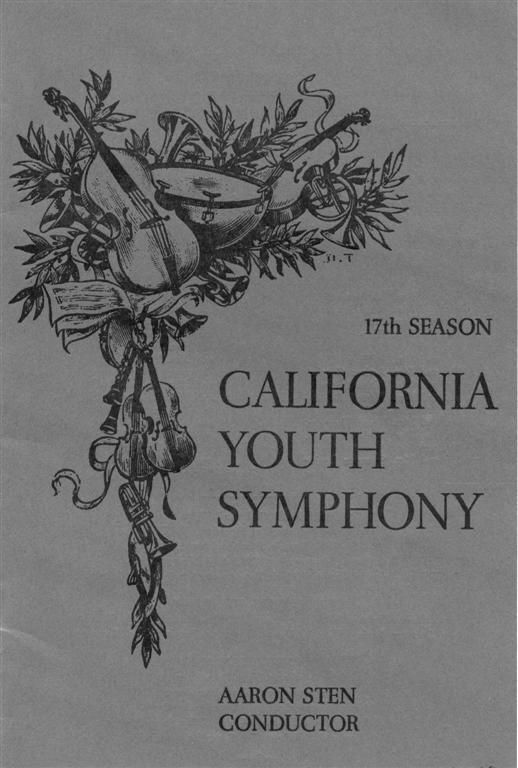
The California Youth Symphony Orchestra, led by Conductor Aaron Sten, launched its 17th Season with its first concert in November 1968. Music enthusiasts had two opportunities to attend: the first on Sunday, November 3, 1968, at 7:00 p.m. at San Mateo High School, and the second on Sunday, November 10, 1968, at 2:30 p.m. at the Foothill College Gym.
The program kicked off with Ludwig van Beethoven (1770–1827)'s Overture No. 3 (“Leonore”), followed by a more modern flair with Alan Hovhaness (1911–2000)'s Fantasy on Japanese Wood Prints, op. 211, showcasing Karol Davis as the Xylophone Soloist.
After an intermission, the concert concluded with Johannes Brahms (1833–1897)'s monumental Symphony No. 4 in E Minor, op. 98, performed in its entirety across its four movements:
I. Allegro non troppo II. Andante moderato III. Allegro giocoso IV. Allegro energico e passionato
February 1968 Concert
Concert Program Overview
CYS presented its 17th Season - second concert across two dates: Sunday, February 23, 1969, at 7:00 p.m. at San Mateo High School, and a repeat performance on Sunday, March 2, 1969, at 2:30 p.m. at the Foothill College Gym.
The program featured an impressive line-up, opening with Samuel Barber (1910–1981)'s Overture to "The School for Scandal," op. 5.
The first soloist of the evening was violinist Robert Levine, the winner of the instrumental division, performing the first movement (Allegro ma non troppo) of Ludwig van Beethoven (1770–1827)'s Concerto for Violin and Orchestra in D Major, op. 61, noting the use of the Cadenza by Fritz Kreisler.
Following the concerto was Howard Hanson (1896–1981)'s Merry Mount Suite, which featured the movements: Overture, Children's Dance, Love Duet, and Maypole Dances, after which an intermission provided a brief respite.
The second half featured pianist Neil Rutman, the piano division winner, performing the three movements of Sergei Prokofiev (1891–1953)'s Concerto for Piano and Orchestra No. 1 in D-flat Major, op. 10:
I. Allegro brioso II. Andante assai III. Allegro scherzando
The program concluded with Nikolai Andreyevich Rimsky-Korsakov (1844–1908)'s vivid Capriccio Espagnol, op. 34, covering its five sections: I. Alborada, II. Variazioni, III. Alborada, IV. Scena e Canto gitano, and V. Fandango asturiano.
Featured Soloists
Robert Levine (Violinist)
Robert Levine was featured as the violin soloist, performing the first movement of the Beethoven Violin Concerto. The program notes from the accompanying newspaper article specify that he was the winner of the instrumental division of the California Youth Symphony Auditions.
At the time of the concert, he was a Senior at Gunn High School in Palo Alto. He had already studied with Conductor Aaron Sten for six years and was the Concertmaster of the California Youth Symphony for five years.
Robert Levine ultimately became a Principal Violist (switching from violin) and enjoyed a highly distinguished career. He served as Principal Violist of The Saint Paul Chamber Orchestra for six years and, critically, served as the Principal Violist of the Milwaukee Symphony Orchestra for over three decades, beginning in 1987. He also performed as a soloist with various orchestras and was a member of the Orford String Quartet.
Neil Rutman (Pianist)
Neil Rutman, the winner of the piano division, was the soloist for Serge Prokofiev's Piano Concerto No. 1. The newspaper notes he was a sophomore at Homestead High School in Sunnyvale and had been studying piano for four years. He was already a highly accomplished young man, having accompanied his school's Choir and Madrigal Choir, and was working on composing a "half completed opera."
Neil Rutman went on to become an internationally recognized and acclaimed pianist. He is a top prize winner of numerous international competitions, including the Busoni, Kapell, and Casadesus competitions, and the International J. S. Bach Competition. He has performed worldwide in prestigious halls like Carnegie Hall and Alice Tully Hall. He is currently an Artist-in-Residence at the University of Central Arkansas and is also a published author on piano literature.
March 1959 Open House Concert
CYS's first March concert was a more traditional symphonic performance and marked the third straight year the orchestra played at the prestigious San Francisco Opera House. The event was sponsored by American Airlines and Radio Station KCBS.
- Program Highlights: The repertoire included standard classical works such as Hector Berlioz's "Symphonie Fantastique" and the world premiere of Carol of the Menlo Park and Manuel Karlin of Palo Alto's "Pine Tree Fantasy."
- The Orchestra's Condition: The article notes that a number of musicians had been ill in February, but the orchestra was expected to be in top shape physically and musically for this major date.
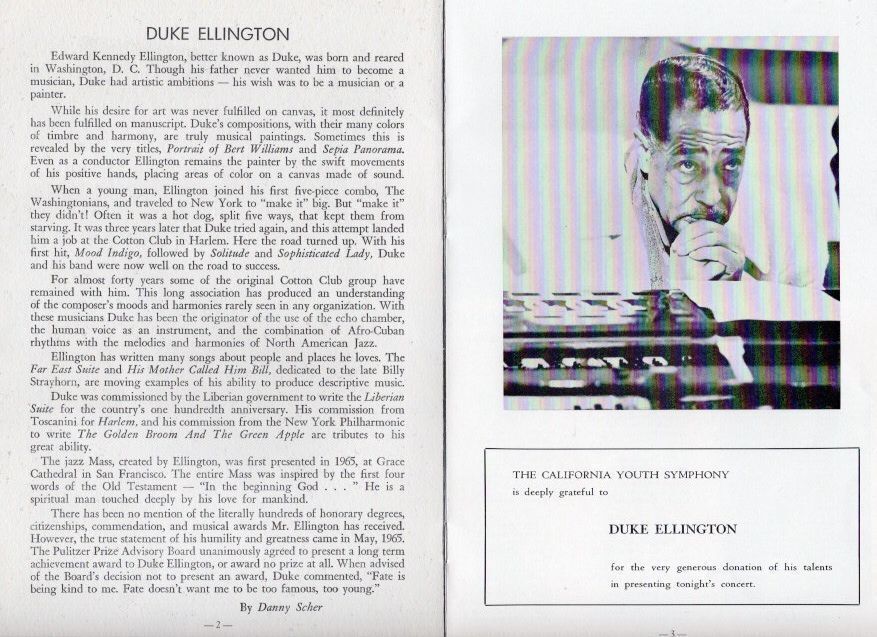
1968–1969 Season Landmark Event: Symphonic Jazz with Duke Ellington
On March 9, 1969, the California Youth Symphony presented a historic benefit concert at Foothill Gym under the direction of Founding Music Director Aaron Sten. The evening celebrated a unique fusion of classical and jazz traditions, headlined by the legendary American jazz composer and pianist Edward Kennedy "Duke" Ellington. Organized to support CYS’s upcoming summer 1969 concert tour to Australia, the performance showcased the extraordinary versatility of our young musicians alongside one of the greatest icons in American music history.
The program opened with classical grandeur, featuring Rimsky-Korsakov’s vibrant Capriccio Espagnol conducted by Aaron Sten. The concert then transitioned into Ellington’s lush orchestral world, highlighted by symphonic arrangements of his beloved classics, including Mood Indigo, Sophisticated Lady, and Solitude. A major highlight of the evening was Ellington taking the stage as narrator, pianist, and conductor for his evocative work The Golden Broom and the Green Apple. Following the intermission, the program featured Alan Hovhaness’s Fantasy on Japanese Wood Prints with xylophone soloist Karol Davis, before culminating in a high-energy suite of Ellington favorites, such as Take the "A" Train, Satin Doll, and Caravan.
Guest Artist: Duke Ellington
Widely regarded as one of the most influential figures in American music, Edward Kennedy "Duke" Ellington brought his peerless artistry and generosity to the CYS stage, donating his time and talents to support our young musicians. Across a career spanning nearly five decades, Ellington transformed jazz from popular entertainment into a profound art form, composing over a thousand works that blended rich harmonies, innovative tone colors, and vivid musical storytelling.
From his early rise at Harlem’s famous Cotton Club to worldwide acclaim as a recording artist and composer, Ellington created enduring classics that defined the American songbook. His ambitious extended compositions—ranging from his sacred music concerts to symphonic suites commissioned by the world's leading orchestras—showcased a painterly approach to sound and a lifelong commitment to spiritual and artistic expression. CYS remains deeply grateful for Duke Ellington's memorable collaboration, which provided our musicians with an unforgettable musical experience on their journey to Australia.
Special Acknowledgment & Historical Archive
We extend a special thanks to alumni Danny Scher for contributing the insightful program essay, "Duke Ellington," featured in the original 1969 concert booklet. His article beautifully captures Ellington’s musical journey, highlighting his unique creative style—where sound was painted onto a canvas of timbre and harmony, and reflecting on celebrated works like Mood Indigo, Sophisticated Lady, and his Sacred Concerts.
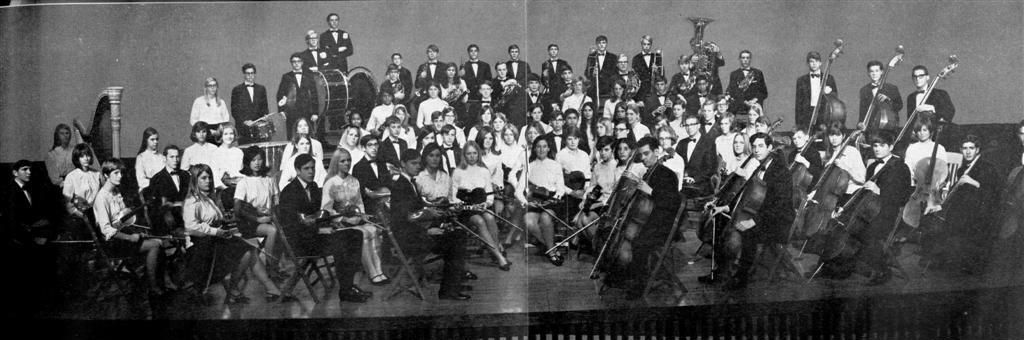
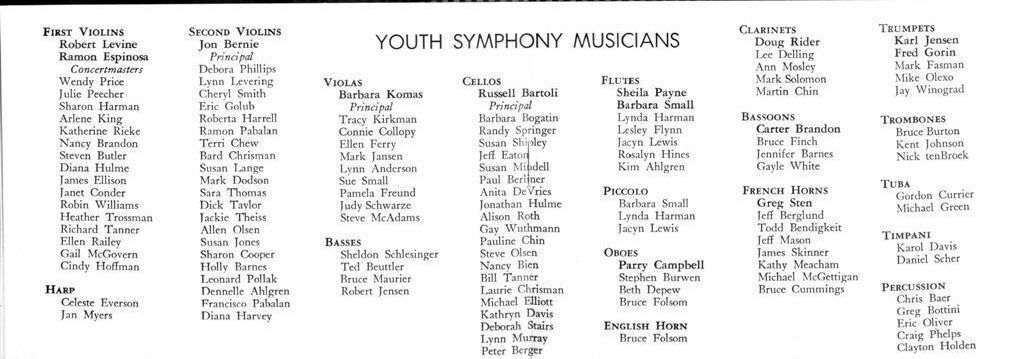
The archive for this landmark concert is further enriched by rare historical photographs, including portraiture of Duke Ellington, conductor Aaron Sten, and the complete roster and group photo of the 1968-1969 California Youth Symphony musicians.
May 1969 Concert
Concert Program Overview
CYS concluded its 17th Season with two significant musical events in May 1969. The month began with a high-profile benefit concert on Sunday, May 11th, at the San Mateo High School Auditorium, designed to secure final funds for the orchestra's Australian tour. The undisputed star of this event was legendary comedian and violinist Jack Benny, who appeared as the guest benefit artist. Benny, noted for his historic fundraising success for major orchestras, performed his signature violin "gala" for the youth musicians, who served as the accompanying ensemble. Following this successful benefit, the orchestra presented its formal 17th Season - Third Concert on two subsequent Sundays. This program featured Bedřich Smetana's lively Overture to The Bartered Bride and his evocative Moldau, alongside Samuel Barber's reflective Adagio for Strings. The program also showcased the final young soloist of the season, Ramon Espinosa, performing the first movement (Allegro non troppo) of Édouard Lalo's Symphonie espagnole. The grand finale of the season was dedicated to Dmitri Shostakovich's powerful and challenging Symphony No. 5, performed in its entirety, providing a formidable conclusion to the orchestra's year before their international tour.
Featured Musicians
Ramon Espinosa (Violinist)
Ramon Espinosa's role in the concert was to perform the challenging first movement (Allegro non troppo) of Édouard Lalo's Spanish-themed showpiece, Symphonie espagnole.
Ramon Espinosa was a young, highly talented musician selected to perform a major concerto with the orchestra, marking a significant milestone in his early career.
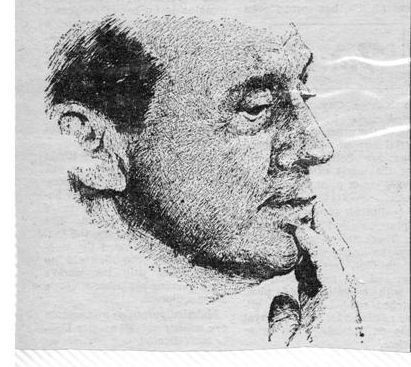
Jack Benny (Comedian and Virtuous Violinist)
Jack Benny (born Benjamin Kubelsky; 1894–1974) was one of the 20th century's most beloved and enduring American entertainers, renowned for his highly successful career in vaudeville, radio, television, and film. He is best known for his comedic persona - a miserly, vain, and famously 39-year-old character known for his impeccable comedic timing and signature exasperated pause.
While his comedy made him a superstar, music was his first love and his constant trademark. Benny began studying the violin at the age of six and was considered a child prodigy, though he often joked about his aversion to practice. He initially pursued a professional career as a violinist in vaudeville theaters. However, after a comedic ad-lib while performing for the U.S. Navy during World War I, he realized his talent lay in comedy.
In his legendary radio and television show, the violin became a running gag; his character notoriously played badly or only attempted pieces that were too difficult. In reality, Benny was an accomplished and proficient violinist who took his music seriously, even owning a Stradivarius.
Throughout his later career, Benny used his fame and genuine musical skill for immense good. He toured extensively, performing benefit concerts - often at no charge - for symphony orchestras across the United States. His appearance with the California Youth Symphony in May 1969 was particularly notable, as the articles stated it was the first time he had given a concert for a youth orchestra, contributing to the millions of dollars he helped raise for music education and arts organizations nationwide.
Summer 1969 Australian Tour
CYS successfully completed its third major international engagement with a memorable four-week concert tour of Australia in June and July 1969.
The trip, made possible by an invitation from the Australian Broadcasting Commission, involved a contingent of 102 teenage musicians (boys and girls aged 12 to 18) from over 40 schools across the Bay Area. Led by Conductor Aaron Sten, the orchestra performed a total of 16 concerts - including five formal evening concerts and seven educational concerts for school audiences - in the major Australian cities of Brisbane, Melbourne, Canberra, and Sydney.
The tour was a resounding success both musically and financially; all concerts were reported to have played to full or sold-out houses, with Australian audiences greeting the young musicians with "enthusiastic audiences and standing ovations." News headlines praised the youths, noting they were "Amateurs With The Touch of Professionalism." The extensive repertoire covered a broad range of music, from classical traditions to works specially prepared for the tour, including pieces by Duke Ellington. Beyond the stage, the most rewarding experience was cultural: the orchestra members were home-housed by Australian families, a practice that afforded them rich and enriching experiences that they cited as the most valuable part of the trip. The successful tour was recognized at home, receiving congratulations from California Governor Ronald Reagan, who called the students "fine ambassadors of our Golden State and the United States."